
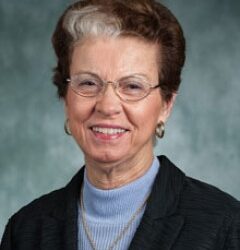
Lusk, Sally Lechlitner
Staff
School of Nursing
Early History
Although the School of Nursing began in 1891 it was a program affiliated with the University Hospital until 1941when it became possible to earn a Bachelor of Science and a Diploma in Nursing by completing three years in the School and two years of science and humanities courses on the main campus. A five-year Bachelor of Science in Nursing was instituted in 1944. In 1952, the program was shortened to four calendar years with the science and humanities courses integrated into the degree program. The first Dean of the School, Rhoda Reddig Russell, the first female dean at the University, was appointed in 1955. At that time, University Hospital established a separate position for its Director of Nursing since Ms. Russell had previously served as Director of Nursing at University Hospital as well as Director of the School of Nursing. Thus, it is safe to say that the School of Nursing did not truly move into academia until the mid-1950s. Although, the School of Nursing had offered electives in Public Health Nursing, it was not until the accrediting body, the National League of Nursing, in 1963 mandated a separate didactic course and clinical experience in Public Health Nursing that it was added to the required curriculum for all students.
My Career
In 1969, just as I had completed my MPH degree in the UM School of Public Health, specializing in Public Health Nursing and Public Health, I was appointed as an Instructor in the Public Health Nursing Area of the School of Nursing. Based on the history provided above, it is apparent that our Area was the “new kid on the block.” We were housed in the basement of Couzens Hall for my first semester of teaching and then when the dormitory wanted its space we were crowded into the lower level of the small School of Nursing building with 5 to an office designed to hold two persons maximum.
Fortunately, our Area Director, A. Josephine Brown, was a strong supporter of her faculty and facilitated my promotion to Assistant Professor in 1971. At that time, none of the School’s nursing faculty had doctoral degrees, although some faculty were enrolled in doctoral programs in other schools on campus. Initially, there had been concern about faculty members enrolling in doctoral programs within the University, but a policy was approved that allowed faculty (and staff) to enroll in graduate programs on a part-time basis, as long as it was not in the unit in which they were employed. The majority of nursing faculty entered one of the School of Education doctoral programs awarding PhDs through Rackham.
As more faculty earned doctoral degrees, the expectations for performance of the faculty role changed. Nursing faculty had always carried heavy teaching loads with many hours spent in the clinical supervision of students, and contributed a great deal of time to service activities within the School and through professional associations, but now there were greater demands for scholarly productivity and conduct of research.
I enrolled in the Educational Psychology PhD program in 1973, completing one to two courses each term while employed full-time as a faculty member, and graduated in 1979, after taking a year’s leave from my faculty position to complete my preliminary examination and dissertation. While a PhD student, I was privileged to be selected to be a fellow on the Hampton – Michigan Project directed by my advisors, Drs. Bill McKeachie and Bettye Morrison. We worked in faculty and student teams to conduct joint research projects at both institutions. As a result, two junior faculty at Hampton University conducted research using the instruments I selected for my dissertation research.
As a part of my faculty position in the SN, from 1971 to 1974, I served as Assistant to the Dean coordinating the academic programs of the Junior and Senior classes. From 1974 to 1978 I assumed responsibility for directing the BSN Completion Program for Registered Nurses who had graduated from hospital diploma programs or associate degree programs.
In 1974, with assistance from the Drs. Jim Greason and Wayne Davis, in the Medical School’s Media office, I was awarded the largest grant the School of Nursing had received to date, a $887,359 Special Projects Grant from HEW to develop a Community-Based BSN Completion programs for RNs to earn a BSN degree. Through this project self-instructional modules and multi-media were developed for all of the BSN program’s required courses. Offices for the three program sites were set up at Northwestern Community College, Traverse City; Kalamazoo Valley Community College, Kalamazoo; and the UM-Flint to coordinate class offerings in those sites and to assist with admissions and communication with students. In cooperation with the University’s Center for Continuing Education, faculty from the Schools of Nursing and Medicine regularly traveled to those sites to teach periodic classes to ensure that the course content and learning was consistent with the on-campus courses. In addition, clinical experiences were arranged in the student’s home areas. Beginning with my leave of absence, the administration of these programs was shifted to the SN Administrative Offices. Ultimately, the UM-Flint established its own on-campus BSN Completion program, and as other schools began to offer BSN programs in Traverse City and Kalamazoo, the UMSN’s programs were phased out there. Thus, all three communities eventually had BSN Completion Programs available through the Universities in their geographic areas. Unfortunately, the School of Nursing did not maintain records of the programs’ off-campus operation by the School of Nursing, but it was estimated that over 2500 RNs in those three areas of the state were enabled to earn the BSN degree through our program.
Thus, this program enhanced the education of nurses around the state of Michigan who otherwise would not have been able to earn a nursing degree. Benefits include making them eligible to enter graduate nursing programs, and to contribute to improved health care in these communities through the advancement of their nursing knowledge. These programs were cited by the University as examples of its community outreach in the state.
After returning from my leave to complete my PhD program in1979, I taught undergraduate and graduate Community Health Nursing courses and initiated research projects regarding factors affecting students’ learning and their attitudes toward client groups. Unfortunately, federal funding was not generally available to support research projects addressing educational issues.
In 1982, Professors Don Chaffin, College of Engineering, and Larry Fine, School of Public Health met with Dr. Violet Barkauskas, chair of Community Health Nursing (CHN) and Dr. Sally Lusk, associate professor of CHN to explore the possibility of the School of Nursing offering a master’s degree program in Occupational Health Nursing (OHN). Master’s degree programs in the College of Engineering and the School of Public Health were already part of the University of Michigan Center for Occupational Health and Safety (COHSE), an education and research center funded by the National Institute of Occupational Safety and Health (NIOSH). There was a desire to comprehensively include all the major professional specialties in occupational health and safety in the COHSE. The proposed expansion would increase the interdisciplinary focus of the COHSE, consistent with evolving NIOSH goals for centers to offer four or more academic master’s programs. This proposal would require the School of Nursing to develop an occupational health nursing master’s degree (MS) program and to partner with the Schools of Engineering and Public Health to submit a request for funding to support the program. Dr. Barkauskas asked Dr. Lusk to take leadership in developing this program and assisted her in doing so.
Funds were received from NIOSH from 1983-85 to determine the need for the program and employ consultants to assist us in planning the curriculum. These funds enabled the conduct and publication of results of two survey research projects that continue to be cited: 1). Assessing the interest of Forbes 500 corporations of employing nurses and the roles they expected them to assume; and 2). Assessing the interests of nurses in Michigan in attending a masters’ degree program in Occupational Health Nursing and the best structure for the program to meet their needs.
Today students and faculty continue to be funded through this NIOSH grant program which began in 1986.
I served as the Director of the OHN program from its inception until I retired in 2003. In 1988 NIOSH added funds to support the MS students’ thesis work, and in 1995 provided additional funds to support PhD students specializing in occupational health and safety topics. If not the first, our program was one of the first PhD programs in nursing to receive NIOSH funding for the PhD occupational nursing specialty. These MS and PhD programs have prepared nurses to lead and direct occupational health services at large entities serving all types of industries, businesses, and health care institutions. Further, PhD graduates are prepared to conduct research to enhance services, develop evidence as a base for practice and promotion of worker health.
With my research program now focused on recipients of care, workers, rather than students, I explored workers’ attitudes and beliefs regarding use of personal protective equipment, such as gloves, respirators, and hearing protection devices. From 1989 to 2003, with funding from several federal agencies, the National Center for Nursing Research, later renamed the National Institute for Nursing Research, and the National Institute for Deafness and Other Communication Disorders at the National Institutes of Health, and the National Institute for Occupational Safety and Health, my projects identified factors determining workers’ use of hearing protection to prevent noise-induced hearing loss. These projects developed and tested media and print interventions (through randomized controlled trials in auto plants) delivered in group sessions to construction workers (operating engineers, carpenters, plumbers and pipefitters) and to individual factory workers via computer.
Prior to my first project, no one had addressed the beliefs and attitudes that influenced workers’ use of personal protection. Instead, research conducted at NIOSH and external projects funded by NIOSH had addressed the efficacy of the personal protective equipment, and not the factors influencing its use. Subsequent to my studies, NIOSH established an intramural research program to assess behavioral factors and began funding extramural projects with this focus as well.
Funding by UAW-GM offered an opportunity to study the effects of noise exposure on other body systems, not just on hearing ability. This seminal project using an innovative approach using surveys, ambulatory blood pressure and heart rate measurement, and personal noise dosimeters worn by factory workers was the first to collect these data while working. We learned that while controlling for other relevant factors, those workers who reported using hearing protection had lower blood pressures and heart rates. Very important, we also found an acute effect of noise: as noise exposures increased, blood pressure and heart rate went up, showing an increase associated with the incremental increase in decibels of noise.
In 1999 – 2000, I was selected to be the American Academy of Nursing Fellow at the US Agency for Health Research and Quality in Bethesda, MD.
I was only able to spend one-half time there due to the demands for conducting my on-going research projects in the auto plants with my team and for administering the OHN programs. This appointment allowed me to interact with occupational health and safety officials in federal agencies and to lobby increased attention to workers’ needs in health research.
With my responsibilities over the years at the University initiating and managing nursing programs and academic programs involving interdisciplinary collaboration, seeking and obtaining external training and research funding, and developing educational products to be distributed, I had the opportunity to work with a significant number of other units in the University. These experiences were always rewarding, and I continue to be impressed with the myriad of support systems for the variety of activities involved in my faculty role. I also had the opportunity to serve on several Senate Assembly committees, with chairing the Financial Affairs Advisory Committee being most enlightening.
To summarize my career at the University of Michigan, I am most proud of the following: facilitating educational advancement for a large number of nurses, including development of the Occupational Health Nursing specialty; establishing a meaningful program of research to benefit workers; aiding effective research design; influencing national policy and research activity to ensure consideration of workers’ attitudes and beliefs about use of personal protective devices; making my research results and instruments available for use by other researchers; and of my mentees who continue to conduct and advance research to promote worker health and prevent noise-induced hearing loss.
I am grateful for the members of my wonderful, dedicated, contributing members of my research teams, including consultants, faculty, and students. I am also so appreciative of the many honors I have received, the opportunity to present and consult in so many places in this country and numerous other countries around the world. I am so humbled by these honors I have received throughout my career and retirement, and I know that the many colleagues and the resources of the University of Michigan were integral to the receipt of those honors.
My Retirement
Since retiring in 2003, my husband and I have traveled to a number of foreign countries along with my maintaining an active role in professional endeavors. I served as the President-Elect, and President of the Midwest Nursing Research Society (MNRS), and after completing that term in 2007 was asked to lead the development of the MNRS Foundation ( a first for regional nursing research organizations). From 2008 to 2013, I served as the President of this entity designed to raise funds to support Dissertation and Seed Grants awarded to nurses by MNRS.
I am now active in the completion phase of research – the translation of findings into policy and the promotion of policy change. My mission now is to reduce Environmental Noise to improve the health of the world! To that end, I have led two American Academy of Nursing teams in preparing a Position Paper and a Policy Brief on the harmful effects of noise and actions that need to be taken. These were adopted by the Academy and guide its policy actions in this area. Our team is now preparing a Consensus Paper of the more recent research documenting the physiological effects of noise and its contribution to health equities. I have also been serving on Boards of organizations dedicated to reducing noise and was a co-author of the American Public Health Association’s Position Paper on Noise as a Public Health Problem.
More detailed information regarding this summary of my career at the University of Michigan can be found in my CV and in Lusk, S.L. (2016). Promoting worker health and safety. In S. Ketefian, (Ed.) Shaping Nursing Science and Improving Health: The Michigan Legacy, (pp 81-95). Ann Arbor, MI: Michigan Publishing.