
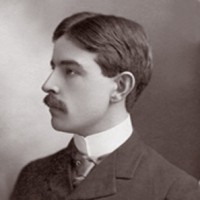
Vice President & Secretary, Business & Finance
University Administration, Alumni Association
Biography/Memoir
SHIRLEY WHEELER SMITH, THE NEW ALUMNI SECRETARY
The Board of Directors of the Alumni Association were fortunate to find at liberty to accept the position of Alumni Secretary, a man so well qualified as the newly elected officer. The duties of the position are such as to call for an unusual range of ability and training; and these are to be increased still more the coming year. As will be seen, however, the new Secretary is peculiarly well fitted for the place. Among the many duties of the position are included the editing and publishing of the Alumnus—in itself no small undertaking; an extensive correspondence with Michigan Alumni; attendance and participation in local alumni meetings all over the country; the solicitation and management of the gifts of Alumni to the University. To these will be added next year the editing and publishing of the University News Letter, and the management of the work on the General Catalog of Alumni. It is no exaggeration to say that on the careful and systematic performance of the duties of this office depends in no small degree the future of the University.
Mr. Smith had three years’ experience in the office of a large manufacturing establishment before entering college. In the University he soon became known as one of the strong men in his class, doing especially good work in English. At the close of his junior year he spent the summer abroad, taking a bicycle trip through the British Isles and across the continent in the capacity of special correspondent for a number of papers. He was on the Daily Board; wrote the class poem in his sophomore year; won the masterpiece prize offered for the best story by the Inlander during his junior year. He was managing editor of the Bulletin and President of his class in the senior year, and devoted the class day address to a plea for the establishment of University Fellowships by local Alumni Associations.
After leaving college, Mr. Smith completed his business training by a year in the assistant management of the manufacturing establishment where he had formerly worked. During this year he was instrumental in the organization of a University Fellowship by the Alumni Association of the Hastings high school, from which he was graduated.
The next year he was called back to Ann Arbor by his Alma Mater and asked to take a teaching position in the English department. This was in the fall of 1898, since which time he has taught in the University. In 1900 he was granted the degree of A.M. It would be noticed then, that Mr. Smith has been in rapid succession, student, businessman, college teacher, and graduate student. He has also kept up his keen interest in literary work. These things have fitted him well to undertake the varied duties of his new position. In addition to them he possesses to an unusual degree the graces of public speech. He is well known among his friends as a famous storyteller, and he will make a valuable addition to the program of Alumni meetings.
Mr. Smith was born in Hastings, Michigan, in 1875, and so begins his work at the advantageous age of 26. He is a son of Judge Clement Smith, of the fifth Michigan judicial circuit. He was graduated from the Hastings High School at the age of 15, and took the degree of B.L. at the University in 1897. He was married in September 1898 to Miss Sara Spencer Brown, also of the class of ’97, and they have one son.
Those who know Mr. Smith best, believe that with his peculiar fitness for the place, and the marked success which has attended his career so far, together with the high character and ability of the man, the work of the Alumni office will be continued with a high degree of success, and they speak for him a hearty welcome and strong support from every loyal Michigan graduate.
The Michigan Alumnus, July 1, 1901, Page 423, by Herbert M. Rich, ’01m
SHIRLEY WHEELER SMITH, NAMED VICE PRESIDENT
New Offices are Created to Aid President Ruthven’s Administration
Plans for the adoption of a new system of administration of University affairs, in which certain administrative duties will be divided between two newly-appointed vice-presidents, were announced on March 13 by President Alexander G. Ruthven. The positions of vice president will be held by Shirley W. Smith, ’97, A.M. ’00, Secretary and Business Manager of the University, and Professor Clarence S. Yoakum, formerly Director of the Bureau of University Research.
In accordance with the statement issued in “The Ruthven Platform” at the time of the President’s election last fall, the new organization is formed “to relieve the President of several duties last year delegated to the Dean of Administration, and permit him to give more time to academic problems.”
Mr. Smith’s official title is now Vice President and Secretary of the University, while Professor Yoakum is Vice President and Director of Educational Investigation Activities.
Mr. Smith has been Secretary of the University for twenty-two years, having assumed that office in 1908, following a term as General Secretary of the Alumni Association. During this time he has served under four different presidents, Dr. Harry B. Hutchins, Dr. Marion L. Burton, Dr. Clarence Cook Little, and President Ruthven, and has seen the University develop enormously, the property value increase many times its original value, and the enrollment practically doubled.
He is a native of Michigan. He was born in Nashville in 1875, the son of the late Judge and Mrs. Clement Smith. Judge Smith was a member of the Law Class of 1867. Shirley Smith enrolled in the University from Hastings, Michigan, receiving his degree in 1897. In 1898 he was added to the teaching staff of the Engineering College, as an instructor in English. He also continued his studies at the same time, and received a Master’s Degree in 1900. A year later he became Secretary of the Alumni Association, a position which he retained until 1904. At this time he severed connections with the University, and was for four years in the President’s office of the Fidelity Mutual Life Insurance Company in Philadelphia. In 1908 he returned to become Secretary of the University of Michigan. In comparatively recent years the title of Business Manager was bestowed upon him.
Professor Yoakum, until his resignation last summer to accept the position of Dean of the College of Liberal Arts at Northwestern University, was a member of the University of Michigan faculty, with the title of Professor of Personnel Administration and Director of the Bureau of University Research. He was born in Leavenworth County, Kansas, and received his A.B. degree from Campbell College, in that state. Some years later, after teaching at the college from which he graduated, at Hiawatha Academy, and at the University of Chicago, he obtained the degree of Ph.D. from Chicago. He was head of the Department of Philosophy and Psychology at the University of Texas from 1908 until 1919. From 1919 until 1924 he was at the Carnegie Institute of Technology, and in 1924 accepted a position at the University as professor. Three years later he was made Director of the Bureau of University Research. Although the change in administration becomes effective at once; Professor Yoakum will not be able to assume his duties until July, owing to his connection with Northwestern.
Other changes incidental to the main reorganization of the administrative system of the University provide for the preparation of the budgets and handling of problems of faculty personnel directly by the president. The faculty committee to the Director of Alumni Relations has been made an administrative committee, composed of President Ruthven, William W. Bishop, Librarian, Dean John Robert Effinger, Professor Lewis M. Gram, of the Department of Civil Engineering, and Dean G. Carl Huber, of the Graduate School. The recently organized University Press has been given a committee with administrative powers. The University Press does not provide a printing establishment; but merely indicates a supervisory element over all University publications. It is headed by Dr. Frank E. Robbins, Assistant to the President.
The reorganization of the administration of the University into a corporation plan is the third important change, which has been effected by President Ruthven within the past month. The first of these was the initiation of changes in the administration of the Medical School. The second was the appointment of Miss Alice C. Lloyd, ’16, as Dean of Women, in place of the committee of three advisers, created by Dr. Clarence C. Little in 1926.
The office of Dean of Administration, which the new system is putting out of existence, was established in 1927 by Dr. Little, and was held by President Ruthven from July. 1928, until he took office as President.The
Michigan Alumnus, March 22, 1930, Page 427
SHIRLEY WHEELER SMITH, MEMOIR
Thirty-seven years ago, on July 14, 1908, Shirley Wheeler Smith was elected by the Board of Regents of the University of Michigan to be their secretary. The institution at that time enrolled 5,000 students; its property was valued at only $4,152,000, and its annual budget amounted to $1,113,000.
In the intervening years thirty-one individuals have been members of the Board of Regents; there have been five Presidents and one Acting President; and the material facilities of the University have grown and its educational programs have expanded in a way never imagined in the early years of this century.
Its student body has reached a maximum of 19,500, its property is valued at $61,500,000, and its annual operating budget is $11,000,000. Of this, the period of greatest change in the University’s history, Shirley Smith has been a living part; his good judgment has been a guide in times of crisis; his integrity has ensured that the operations of the institution should never suffer from suspicion and harmful criticism; his ability to organize large enterprise and to work with others in its execution has been a secure and dependable asset upon which the Regents could at all times rely; and beyond the bounds of our own campus, among the universities of the whole country, he has rightfully become known as one of the leading educational administrators of our time.
His capacity for staunch friendship, his delightful humor, and his entire devotion to Michigan and those connected with Michigan has made his able service as the University’s chief financial officer yet more noteworthy and effective.
Difficult as it is to give appropriate expression to their appreciation for a record so distinguished and memorable, the Regents of the University of Michigan have nevertheless adopted the foregoing preamble for inclusion in their Proceedings and transmittal to Vice President Smith, together with the following resolutions:
Resolved, That the profound thanks of this Board be extended to Vice President and Secretary Shirley Wheeler Smith for his noteworthy services to the University of Michigan, together with their cordial hope that the period of his retirement may be a long and happy one, and be it further
Resolved, That he be permitted to retire from his active status on June 23, 1945, with the title Vice-President and Secretary Emeritus, and with retiring allowance as provided by the Bylaws, and be it further
Resolved, That Mr. Shirley Wheeler Smith be invited to avail himself of all the usual courtesies extended to officers emeritus, and in particular to consider himself a welcome guest at the meetings of this Board at such times as may be convenient to him.
Regents’ Proceedings, June 1, 1945, Page 954
SHIRLEY WHEELER SMITH RECEIVES UNIVERSITY OF MICHIGAN HONORARY DEGREE
DOCTOR OF LAWS
SHIRLEY WHEELER SMITH. A graduate of the College of Literature, Science, and the Arts in the Class of 1897; Master of Arts in 1900; formerly Instructor in English; for the past thirty-seven years chief financial officer of the University. In his long association with Michigan he has shown unrivaled competence in administering the complicated tasks entrusted to his care. His acumen in matters of business and finance has promoted the material well being of the University; his devotion to its ideals has been a source of spiritual strength. The stamp of his vigorous personality will long remain firmly fixed on the institution which he has served with such singleness of purpose and enduring results.
Regents’ Proceedings, June 1, 1945, Page 962
SHIRLEY WHEELER SMITH, OBITUARY
The Regents adopted the following memoir in honor of Mr. Shirley Wheeler Smith, Vice-President and Secretary Emeritus of The University of Michigan, who died February 16, 1959:
Death came February 16, 1959, at age eighty-three, to Shirley Wheeler Smith, Vice-President and Secretary Emeritus of The University of Michigan.
His association with the University covered forty-seven years, first as Instructor of English, then as General Secretary of the Alumni Association, and last as Vice-President and Secretary.
After he retired from his official duties, Mr. Smith wrote the biographies of Harry Burns Hutchins and James Burrill Angell, literary labors that would test the powers of a much younger man. Plain in his own wants and habits, he reflected these characteristics in his writing.
Jealous of the University’s good name, he added much to her reputation for frugal living and high thinking. In his last years he played the part of elder statesman to his community. Young and old sought his sound judgment, valued highly his prudent advice, and treasured his keen wit.
The Regents mourn the death of Shirley Wheeler Smith, respected citizen, wise counselor, and trusted friend of The University of Michigan. They express their deepest sympathy to his family, and mourn with them and with the University alumni a great loss.
S. W. Smith: Regents Bonisteel and Power paid special tribute to Shirley Smith. Tributes to Regent Bonisteel characterized him as “a great alumnus, whose life spoke for itself, in all its many phases of his relation to the University, in the Rotary Club, and in his association with the Ann Arbor Bank. He was keenly alert to everything about him. The community will miss him greatly.” Regent Power remembered that he himself was “one of the young men who came for advice and counsel to Mr. Smith and who was helped and enlightened.”
Regents’ Proceedings, February 1, 1959, Page 780